Friday, March 20, 2020

Quitting Time!

The Day the Crayons Quit 
Written by: Drew Daywalt      Illustrated by: Oliver Jeffers
Published by: Phiomel Books, 2013
Modern fantasy

One day while at school, Duncan went to take out his crayons and found a stack of letters addressed with his name. As he reads through the letters, Duncan comes to realize that all of his crayons have decided to quit! Gray Crayon is tired from coloring all of the big elephants and whales. Beige Crayon is tired of constantly being called light brown. And Yellow and Orange Crayon cannot agree of who is supposed to color in the sun. Will Duncan ever be able to make all of his crayons happy or will they leave him colorless?

The illustrations of this book are what make the story worthwhile! There is no traditional typed text in this story but rather pictures of letters written with crayon, appearing to be written by the crayons themselves. Their are also crative drawings appearing to be drawn by Duncan, that are used to show exactly what each crayon is tired of. The illustrations are lively and full of color which perfectly captures the imigination of a child with a box of crayons. 

One way this book could be used in a classroom would be to discuss the format for writing a letter with second graders. The teacher could use the crayons' letters to Duncan as examples and have the students write their own letter to their crayons using the letter styling they see within the book.  

Image result for the day the crayons quit

Monday, March 2, 2020

You Hold Me, I Hold You

You Hold Me Up 
Written by: Monique Gray Smith     Illustrated by: Danielle Daniel 
Orca Book Publishers, 2017
International literature

What are some ways that we can hold each other up? This book helps students see and make connections to many ways in which they can "hold each other up" through showing support and friencship to one another no matter the situation. This book is full of encouragement and helps promote a risk free classroom environment that students will feel safe and accepted in. A must read for any classroom!

The illustrations in this book are composed of bright watercolors and acrylics. The pictures themselves, however, are fairly simple with little detail and consist of mostly lines and circles. Each illustration promotes diverse cultures and interests by displaying different groups of people doing activities such as cooking, playing, and making music.

One way that I could use this book in the classroom setting would be to read this story to kindergarten or first grade students during the first week of the new school year. After reading, I and my students would participate in creating an anchor chart to build our classroom rules together. This activity would allow the students to set their own expectations based on the the supports seen throughout the book. This will make the rules more meaningful for students because they created them and allow them to feel a sense of unitity.  

Image result for you hold me up cover

Happines from within

 Happy in Our Skin
Written by: Fran Manushkin    Illustrated by: Lauren Tobia
Candlewick Press, 2015
Diverse literature 

Have you ever thought about how wonderful it is to have skin? "It keeps our outsides out and our insides in." This book highlights the different physical features of a biracial family and how even though the children's skin may look different than their light-skinned mother, they all share similarities. This book is a great read for students as they can relate their differences with the family from the story and find acceptance in everyone, no matter how different they may seem!

The illustrations in this book are classified as mixed media illustrations. The illustrator uses many different methods such as watercolors, electronic media, oils, and pencil to create the amazing images. The images themselves demonstrate a vast variety of diversity in that they contain people with many differences. Some images contain people of different races and genders. Other include people with disabilities, birthmarks, glasses, etc.

I would choose to teach this book in a kindergarten setting, with my content focus being art. I would first share this story with my students then have them create a self portrait to share with the class. The students will highlight things that make them different in their portraits and share them verbally with the class.


Monday, February 3, 2020

Fun at the Farm

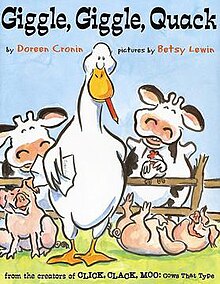
Giggle, Giggle, Quack 
Written by: Doreen Cronin Illustrated by: Betsy Lewin
Scholastic Inc. 2002
Picture book 

All is well on the farm, until Farmer Brown decides to take a vacation. Farmer Brown leaves his brother, Bob, in charge of the animals and assures him that as long as he follows the notes left for him, all will be fine. The notes, however, start to look a little funny once Duck finds a pencil and some paper. How much trouble can the animals get into while Farmer Brown is away?

The illustrations in this book are all brush drawings done first with black watercolor on tracing paper, then photocopied on watercolor paper where watercolor washes were added to the black drawings. 

I chose first grade English Language Arts as my content area for this picture book. I would incorporate this book by reading it with the students, then having them retell the story using transition words. Once we identified the important events in the correct order, the students could create a retell booklet where they write the sequence of events and can add their own illustrations.


Gigglegigglequack.jpg

Friday, July 26, 2019

Whole Brain Teaching

Image result for whole brain teaching


Whole brain teaching refers to a set of strategies that are used in classrooms everywhere to maximize active learning and student engagement. The idea behind whole brain teaching is to focus on the way that the brain was designed to learn and to activate each part of the brain individually. Whole brain teaching can easily be modified to better accommodate any grade level or specific class needs, but generally follows the same seven major “rules” in any school. These seven rules do not follow any specific order and can be used in any variation but are designed to activate each area of the students brain and effectively manage the classroom. The seven major rules to using whole brain teaching are named: class-yes, teach-okay, switch, scoreboard, hands and eyes, class rules, and mirror. Each of the seven rules bring something different to this teaching approach but together they accomplish all of the following: grabbing the students immediate attention, engaging the students brain, directly instructing the class, allowing the students to work collaboratively, and character education. The methods used for whole brain teaching are all research based and can be used as early as pre-k. Check out the video below to see whole brain teaching in action!
I believe that whole brain teaching is overall a great way to help your students get the most out of classroom instruction. The rules are designed to challenge the students to remember what is taught and then teach the material to a peer. The rule that I find most interesting of the big seven is scoreboard. This teaching strategy is used mostly as a way to improve classroom management but can be modified in almost any way to become whatever the teacher and students want it to become. In this strategy, the teacher will come up with a scoreboard to keep track of anything she wants to keep track of. The teacher might want to track students good and bad behavior or even track their academic performance. I like this teaching strategy the best because it can be used in a variety of ways to motivate students in any way the teacher sees fit. Scoreboard can also be modified to give students rewards to add extra motivation.  Image result for whole brain teaching


Thursday, July 25, 2019

Professional Learning Networks

Professional learning networks (also sometimes called a personal learning network) do not exist only within education, every profession has them. In the teaching field, a professional learning network is created when several educators join together to plan, experiment with new ideas, and develop quality learning activities for their students. A single network can consist of people all from the same school or even stretch across the country with hundreds of educators joining. It is even considered beneficial to have people in a professional learning network that do not all share the same profession. For example, why would we only include teachers in our network when counselors, principles, and media specialists might also have fantastic ideas about education. 

Image result for professional learning networks By creating these networks, teachers are introduced to new ideas for teaching, different resources, and the newest strategies in the education field. They also allow for teachers to share their thoughts and ideas with other educators and receive constructive feedback on their ideas. For anyone to be an active member of a professional learning network, one must both take away information as well as contribute their own knowledge. With technology today, professional learning networks are easier to keep up because communication can occur online via email, Skype, or any other digital communication means. Teachers involved in these groups must be imaginative, innovative, determined to better the education of students, and encourage a changing environment in order to see what works best in the classroom.
Image result for professional learning networks

When I started learning about personal learning networks, I had no clue what they were or how to build one. I find professional learning networks to be extremely useful in the world of education and very easy to become a part of with the help of social media. In order to offer students the best education possible, we must stay up to date on all new teaching strategies and not be afraid to explore different options and methods for teaching. The video below shows viewers exactly what a professional learning network looks like, how to get one started, and the tools needed to keep the network running.